

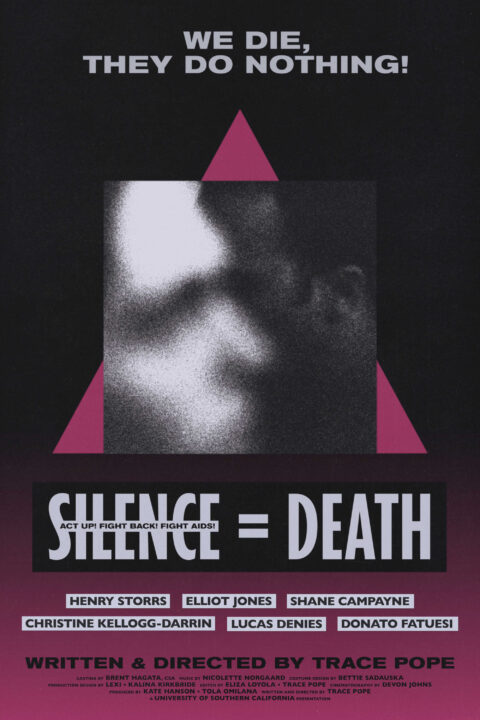
Runtime16mGenreDrama, ShortDirected byTrace PopeWritten byTrace PopeStarringHenry Storrs Elliot Roy Rensky Shane CampayneDistributed byUniversity of Southern California
‘Silence = Death’ Review: A Look at Dr. Fauci’s Legacy Through a Queer Lens
This short drama shows the early days of Dr. Fauci's more divisive views during the '90s AIDS epidemic.
Many people considered Dr. Anthony Fauci, a pinnacle figure during the COVID-19 pandemic, as a hero. His expert advice was viewed as a guideline for the health and safety of society. His words were interpreted as gospel, and many believed he could do no wrong. However, his status as a hero in healthcare remains questionable to some. In filmmaker Trace Pope’s short drama Silence = Death, Pope shows the early days of Dr. Fauci’s more divisive views during the ’90s AIDS epidemic.
The Fight Against Dr. Fauci
The year is 1990, and Jamie (Elliot Roy Rensky), a young, queer activist and filmmaker, prepares to confront Dr. Fauci. Jamie is tired of watching his partner, Patrick (Shane Campayne), suffer from complications from AIDS, and knows he needs to get proactive. Using his camera as his tool, Jamie joins an upcoming protest to storm the DC campus of the National Institutes of Health (NIH). This event, led by the AIDS Coalition to Unleash Power (ACT UP), is protesting the lack of available drugs to treat AIDS, a cause clearly very personal to Jamie.
While protestors ascend the building, Dr. Fauci (Henry Storrs) can only watch. They scream for his resignation and threaten to upend his work. Jamie, however, remains measured and calm. When he spots Dr. Fauci behind a glass door, he attempts to hand him a package that contains a video of his partner. The hope is that this will humanize the image of the AIDS crisis and change Dr. Fauci’s mind. Despite the effort and intent, Jamie’s effort can only go so far. At the end of the day, it is Dr. Fauci alone who must reckon how he will utilize with his power and privilege.
“You Are a Murderer”
“Anthony Fauci, you are a murderer,” Jamie says defiantly in the opening scene. This divisive statement hits hard, especially when followed by the slogan “One AIDS death every 12 minutes.” Filmmaker Trace Pope doesn’t hold back as he shines a light on this historical moment. Most notable is the strong editing, which blends archival footage from former protests. This is an incredibly effective decision that displays Pope’s creative control. The performances in Silence = Death are incredibly intimate and moving. Initially, I mistook the film for a documentary (that’s how convincing Elliot Roy Rensky is on screen).
Director’s Statement
“When ACT UP was founded in 1987, the world witnessed the birth of one of the most influential activist groups in history. Because of their direct action and protests, the NIH (led by Dr. Anthony Fauci) accelerated the production of drugs that have significantly limited the reach of this horrible disease… Last year, the NIH terminated almost all of its grants that fund HIV/AIDS research, effectively ending the search for a vaccine and endangering the lives of millions of people. This film is my attempt to immortalize the bravery of the activists who fought for our survival 40 years ago and caution against complacency as this cycle of discrimination spins on.”
Takeaway
Silence = Death makes a strong statement that intends to educate and alert its audience. Through powerful storytelling and convincing performances, Silence = Death carries a loud message. The film received a nomination for Best Narrative Short at the March on Film Festival.

