

'Tea with the Dames' Review: Legends Unite
In director Roger Michell's documentary, Tea with the Dames, the legendary stage and screen icons Eileen Atkins, Judi Dench, Joan Plowright, and Maggie Smith candidly discuss their careers, friendships, and lessons they've learned along the way.
Just as they were back then, these artists continue to be a sign of independence and inspiration for future generations, and a much-needed symbol of strength for women in these trying times.
Despite their bustling careers and hectic schedules, the four Dames have always found time to meet in the English countryside to let their hair down, gossip, and catch up with each other. But this is the first time they have let cameras into the sacred space of their loose and relaxed banter. The result is an interview style, which includes breaking the third wall numerous times, lending to the film's overall feeling of inclusion along with admiration. In talking so candidly with the production crew and each other, the women let their guard down and give off the impression that we are all old friends, which is a warm, wonderful feeling.
"Whatever it is, it's too late," Maggie says with defeated breath.
"Oh," Joan exclaims, "but it's never too late."
Like a refined version of The View, or the "Pickalittle" ladies from The Music Man, the Dames are chatty, giggly, and honest. They talk openly about their fear of being approached to play Cleopatra, with Eileen and Joan flat out refusing to ever play the iconic character. Maggie admits she was terrified and only took the part in a Canadian production to escape harsh criticism elsewhere, and when Judi hesitantly accepted the part, people laughed openly at her performance. "Critics believe we think we're the bee's knees," Joan goes on to say, "...they don't know that we're shaking inside."
A fascinating retrospective of some of the most notable actresses in history, Tea With the Dames is a touching tribute to the women who contributed to shaping the dramatic arts. Pioneers in their own right with voluminous careers to reflect upon, the Dames are asked poignantly in the film’s finale if there was any advice they would give their younger selves. Joan says she would have liked to have discovered yoga and mindfulness at a younger age. Eileen says she would like to have listened more and quit her bad temper. Joan heartbreakingly says she would have tried not to be so susceptible to falling in love. Maggie admits she doesn't know what she would tell herself because she "wouldn't be listening anyway." After a laugh she answers more truthfully, her advice being "When in doubt, don't."
"Whatever it is, it's too late," Maggie says with defeated breath.
"Oh," Joan exclaims, "but it's never too late."
'Tea with The Dames' is not rated. 94 minutes. Now playing at Laemmle's Royal Theatre and streaming on Amazon Prime.


'Solace' Review: An Honest Reflection of Mental Health
Solace is a breath of fresh air.
With writer/director Tchaiko Omawale at the helm, this coming-of-age story doesn't tackle the stereotypical issues seen in many other young adult films. Here, Omawale pushes boundaries with Solace's progressive subject matter, which includes self-harm, eating disorders, and body dysmorphia, all set in the upper middle class of Ladera Heights, a predominantly African American community. The LA Film Festival is the perfect launching point for a film like Solace, and it's my hope that this film continues to be shown around the world because issues like the ones seen here are not exclusive to Los Angeles.
Seventeen-year-old Sole (Hope Olaide Wilson) is struggling. After her father's death, the New York City teen is ordered by the court to relocate to Los Angeles to stay with her last living relative, her maternal grandmother, Irene (Lynn Whitfield). Irene's church-going and preachy behavior doesn't sit well with the defiant Sole, whose atheist and vegan ways are consistently at odds with her elder. Sole feels like no one understands her, and so she turns to food for comfort. Binge eating takes the pain away, if only for a few moments.
'Solace', the newly announced LA Muse Special Mention and Best Ensemble Cast winner, stands out as a great independent film with a fantastically relevant social message.
Looking for a way out of LA, Sole discovers a performance art grant that promises a trip back to New York. Desperate to go back to the life she had, Sole recruits her next-door neighbors Jasmine (Chelsea Tavares) and Guedado (Luke Rampersad), who also seem to be societal misfits, to help her achieve her goal of getting the grant. It's while working with them that Sole finds solace in this chosen family while simultaneously discovering herself along the way.
Acknowledging and overcoming self-destructive behaviors is at the heart of Solace, and the most important take away is realizing that we all struggle with something. External behavior doesn't necessarily reflect the emotional struggle one may be going through, regardless of age, gender, and race. Hope Olaide Wilson's performance is strong and heartfelt, making her a character we can all find a way to relate to.
Solace is a bold new voice in the filmmaking arena and with its timely message of women taking a stand and having their voices be heard, director Tchaiko Omawale has not only made a great film with distinctively stylish cinematography, but also an honest reflection of mental health. Solace, the newly announced LA Muse Special Mention and Best Ensemble Cast winner, stands out as a great independent film with a fantastically relevant social message.
'Solace' is not rated. 81 minutes.

'Ashes in the Snow' Review: Big, Bold, and Beautiful
Having its world premiere at the LA Film Festival, Ashes in the Snow is not for the faint of heart.
This coming of age story is a heartbreaking tale of innocence and young love set against the brutally cold and dismal backdrop of remote Siberia. In director Marius Markevicius' historical drama, based on the novel Between Shades of Gray by Ruta Sepetys, one teenager's resilience and passion for finding the will to create art even in the darkest of situations is a touching and tender watch.
Set in 1941, in the middle of WWII, sixteen-year-old Lina (Bel Powley) is a talented artist living at home in Lithuania with her mother, Elena (Lisa Loven Kongsli), father, Kostas (Sam Hazeldine), and younger brother, Jonas (Tom Sweet). One unsuspecting night, a group of Soviet officers kidnaps the family from their own home and forcibly puts them, along with hundreds of other captives, on a train to one of Joseph Stalin's work camps in Siberia. Devastated and confused, yet trying to be strong for her mother, Lina realizes that continuing to create her art could lead to freedom, if not physically, then at least mentally.
Ashes in the Snow is a great character study of the depths of humanity and the duality of man's capabilities when put in situations with dire consequences. Screenwriter Ben York Jones, who recently added creator credit to his resume with the Netflix series Everything Sucks!, is no stranger to developing passionate and affecting love stories. A frequent collaborator with director Drake Doremus (Newness, Like Crazy), Jones brings visceral heartache and layered character complexity to this independent film, proving once again that a good love story can transcend time.
The colors are crisp and bold, the landscape is vast and unrelenting, and even the dirt that covers the Lithuanian's faces can't hide their beauty.
The conflict between Lina's mother, Elena, and the baby-faced young Soviet soldier Nikolai Kretzsky (Martin Wallström) provides much of the film's electric tension. Nikolai confides to Elena that he shares her feelings of frustration about the position he has been put in. However, their shared feelings toward their mutual circumstances aren't enough to form any sort of bond or sympathy. The two develop a dysfunctional relationship that stands in complete contrast to the evolving relationship Lina finds herself in with a fellow prisoner, Andrius (Jonah Hauer-King). A slight nod to the Shakespearean dilemma of two lovers being torn apart by their surroundings, their optimism is a much-needed signal of strength.
The colors are crisp and bold, the landscape is vast and unrelenting, and even the dirt that covers the Lithuanian's faces can't hide their beauty. A powerful story that is equally matched with breathtaking cinematography and a haunting score from German pianist and composer Hauschka (real name Volker Bertelmann), Ashes in the Snow is a cinematic triumph.
'Ashes in the Snow' is not yet rated. 98 minutes.

'The Old Man & The Gun' Review: Smooth Criminal
Most senior citizens find excitement in winning Bingo at their local community rec center, but not Forrest Tucker.
No, this 70-year-old finds joy and satisfaction in robbing banks. In the highly anticipated film from director David Lowery, The Old Man & The Gun is a high energy, high stakes crime comedy that feels like The Place Beyond the Pines set a few decades in the past and with Ryan Gosling aged about 50 years. But what is most fascinating about Forrest Tucker and The Old Man & The Gun is that this unbelievably fascinating story is (mostly) true.
In his final acting role, the charming Robert Redford plays Forrest Tucker, an American career criminal who spent his whole life getting thrown into and breaking out of prison, 18 times to be exact. When we meet him, he had already escaped from California's San Quentin State Prison via a handmade kayak (with the slogan 'Rub a Dub Dub' etched into the side) and was knee deep in completing a sling of successful bank robberies. At 70-years-old, he, along with his two aging accomplices Waller (Tom Waits) and Teddy (Danny Glover), is the perfect criminal. Not only because he looks totally incapable of making off with thousands of dollars at gunpoint, and therefore has been overlooked by police for years, but because he is just so gosh darn nice to his victims. He is a criminal with a heart of gold.
His niceness also wins over the heart of Jewel (Sissy Spacek), a woman he meets while dodging the boys in blue. Forrest proves that he can be both a gentleman and a robber, and this paradox makes for such an enjoyable character arc as he is faced with the highs and lows of his unconventional profession. One person who isn't so amused with his antics is Officer John Hunt (Casey Affleck), a 40-year-old family man who finds himself two steps behind the senior citizen criminals, who he's dubbed the "Over the Hill" gang. Despite Forrest being the "bad guy" (technically speaking), I found myself rooting for his success and honestly, in a twisted way, it seems as if John Hunt wants Forrest to succeed as well.
Forrest proves that he can be both a gentleman and a robber, and this paradox makes for such an enjoyable character arc as he is faced with the highs and lows of his unconventional profession.
Director David Lowery is a master at incorporating poignant musical artists in his films. In 2017's A Ghost Story, he used the L.A.-based indie band Dark Rooms to bring the moodiness and mystic with their song I Get Overwhelmed (which has since become of one my favorite emo anthems). The Pete's Dragon soundtrack includes an eclectic group of artists, incorporating the specific sounds of Leonard Cohen, St. Vincent, and The Lumineers. In The Old Man & The Gun, Lowery continues this fantastic merging of mediums by using an unexpectedly fitting uptempo jazz score throughout the film. What really knocks it out of the park is the use of Jackson C. Frank's Blues Run the Game, in its original recording, during a final chase montage. The crackling of the vinyl and the smoothness of Frank's voice is the perfect compliment to Tucker's aesthetic and one of the film's more memorable moments.
Lowery has created a brilliantly entertaining and rich film with The Old Man & The Gun. From start to finish, Robert Redford captivates with his charming personality and confidence. It is also refreshing to see a love story unfold between Forrest and Jewel. That initial spark that ignites when you realize you've met "the one" is usually only seen between younger characters, but Lowery gives the older generation another chance to experience this delicate part of life, proving you're never too old for love... and money.
'The Old Man & The Gun' is rated PG-13 for brief strong language. 93 minutes. Opening this Friday at ArcLight Hollywood and the Landmark.

'All About Nina' Review: Little Girl Lost
As a female director in the stereotypically "man's world" of filmmaking, Eva Vives knows a thing or two about standing out.
In a male-dominated industry, many women find it challenging to be taken seriously based on her gender. Vives takes this struggle to the stage in her first feature-length film All About Nina, a story that combines heart and humor with the reminder that nothing is out of reach with the determination to succeed and a drink now and then for when the times get a little tough.
It's hard enough out there for a comedian, and nobody knows that better than 33-year-old New Yorker Nina Geld (Mary Elizabeth Winstead). Known as the girl who talks about having sex, wanting sex- basically anything sex-related. Her material may be provocative and profanity-ridden, but she worked hard to get to where she is and embraces every laugh and giggle as validation of her success. While her onstage persona may be on track, off the stage, she is a little girl lost. It is common for her to get drunk after stand-up sets, taking home random men, and all the while partaking in an unconventionally dysfunctional affair with a married man (Chace Crawford). When the chance for a fresh start in Los Angeles presents itself, Nina packs up and heads to the city of angels without hesitation.
Sometimes, one needs to have an emotional breakdown to have a breakthrough.
The people she surrounds herself with make all the difference for Nina. Landing in Silver Lake, her housemate Lake (Kate del Castillo) acts as the hippie mother-figure she always wanted, and her new love interest Rafe (Common) shows her what true love and support feels like. Of course, Nina's previous baggage begins to infiltrate her newly curated life, as she questions if the happiness she feels is real or superficial. But the bigger question is still- does she deserve this newfound happiness?
Right off the bat, an obvious comparison to All About Nina is the Jenny Slate-starring film Obvious Child. Both Slate and Mary Elizabeth Winstead play young women navigating the choppy waters of the comedy scene in the big city and the mental torture they endure from their romantic relationships (both past and present). In this role, Winstead shines as Nina. She is not only traditionally funny with her spot-on celebrity impressions and well-timed jokes but is also able to play up Nina's vulnerabilities and insecurities, making her a protagonist worth caring about. Any other actress in this role could have been off-putting or too biting, but Winstead is likable enough that even at Nina's worst, we still root for her. It also helps that she's not afraid to get dirty, speak crudely, and look silly on stage.
Working through internal pain by way of comedy is a formula every comedian knows well, and All About Nina is a great example of dealing with life's struggles. Sometimes, it just takes an emotional breakdown to have a breakthrough.
'All About Nina' is rated R for strong sexual content and language throughout, some nudity and brief drug use. 97 minutes. Opening this Friday in select theaters including AMC Sunset 5.

'Assassination Nation': Hell Hath No Fury Like A Teenage Girl Scorned
"This is the story of how my town, Salem, lost its fucking mind."
From the very first shot, director Sam Levinson doesn't shy away from putting it all out there in Assassination Nation (which includes a "trigger warning" message, for those wondering what exactly this wild 110-minute ride will contain). In this provocative story about how a group of teenage girls fell victim to a county-wide hacking incident and then found themselves on the receiving end of the chaos, Assassination Nation is a delightfully disturbing film with a (pun intended) killer soundtrack to match.
Lily (Odessa Young) and her friends, Bex (Hari Nef), Sarah (Suki Waterhouse), and Em (Abra) are typical, albeit incredibly stylish, teenage girls. They flirt with boys via texts and at booze-fueled parties, and have complicated relationships with their parents and classmates. The social media age they live in has them growing up way too fast, with a false sense of security that what happens online, stays online. The hacking starts small. First, it's the town's Mayor whose closeted gay, kink lifestyle gets exposed. Then it's high school principal Turrell (Colman Domingo) whose seemingly innocent photos of his underage daughter are suddenly viewed as child pornography. Salem County is imploding from the inside with the deepest darkest secrets of its residents, but things get personal for the girls when Lily's private text messages between her and her mysterious "Daddy" are plastered all over the internet- provocative pictures and videos included. Despite being a victim herself, Lily and her friends are getting blamed for the hack, and soon realize that with that blame comes a potentially deadly outcome.
Think Ingrid Goes West meets It Follows meets Netflix's 13 Reasons Why with a modern day twist on the Salem Witch trials of 1692 and you'll have a slight idea of what to expect in Assassination Nation. Odessa Young gives a powerful performance as the protagonist who is a no-holds-barred badass. Hari Nef as Bex steals every scene by balancing confidence and vulnerability. The film wouldn't be the same without its supporting actors Bill Skarsgård, Joel McHale, and Bella Thorne, and they bring the thrills, chills, sex, scandal, violence, and vengeance to new heights.
Perhaps one of the more influential soundtracks to assist any film this year, every piece of music in 'Assassination Nation' compliments the film's DGAF attitude of teenage angst and anti-establishment.
Levinson's directorial approach to telling the story of Assassination Nation is unexpectedly theatrical. He incorporates clever lighting techniques that are usually reserved for a performance on the stage, like dimming the brightness to signal a sudden shift in action. Incorporating a three-way split screen to simultaneously show the characters and their whereabouts feels fresh and progressive. The inclusion of one-take shots, most notably the scene inside and around Em's home, are breathtaking. It demonstrates his creativity as well as technical skill, and the result makes for many memorable moments.
Last but not least, the soundtrack. Perhaps one of the more influential soundtracks to assist any film this year, every piece of music in Assassination Nation compliments the film's DGAF attitude of teenage angst and anti-establishment. Fuzzy electric guitars and pulsing bass lines are prevalent throughout the film and provide an emotional release to the girl's feeling of entrapment and desperation. A powerful score from composer Ian Hultquist (who is also a founding member of the band Passion Pit) relies heavily on synth and trap beats that perfectly play to the images onscreen. Music supervisor Mary Ramos balances these heavier audible moments with more delicate songs that give the film breathing room, most notably the inclusion of ANOHNI's 'In My Dreams.' I also highly recommend staying through the credits, you wouldn't want to miss iconic marching band, The Sonic Boom of the South's, rendition of Miley Cyrus' 'We Can't Stop.' That song has never sounded better.
Assassination Nation is a cinematic feast for the senses. Visually, audibly and beyond, we are violently thrust into Levinson's chaotic world that, at times, doesn't feel far off from our own. There is no doubt that the film's inspiration stemmed from the current state of affairs and the ongoing fight against righteousness and hypocrisy. It isn't the violence and bloodshed that makes Assassination Nation a "thriller," it's the fact that this could be our future if we're not careful about our actions today.
'Assassination Nation' is rated R for disturbing bloody violence, strong sexual material including menace, pervasive language, and for drug and alcohol use - all involving teens. 110 minutes. Opening this Friday in theaters everywhere.
'The Sisters Brothers' Review: A Wild, Wild Watch
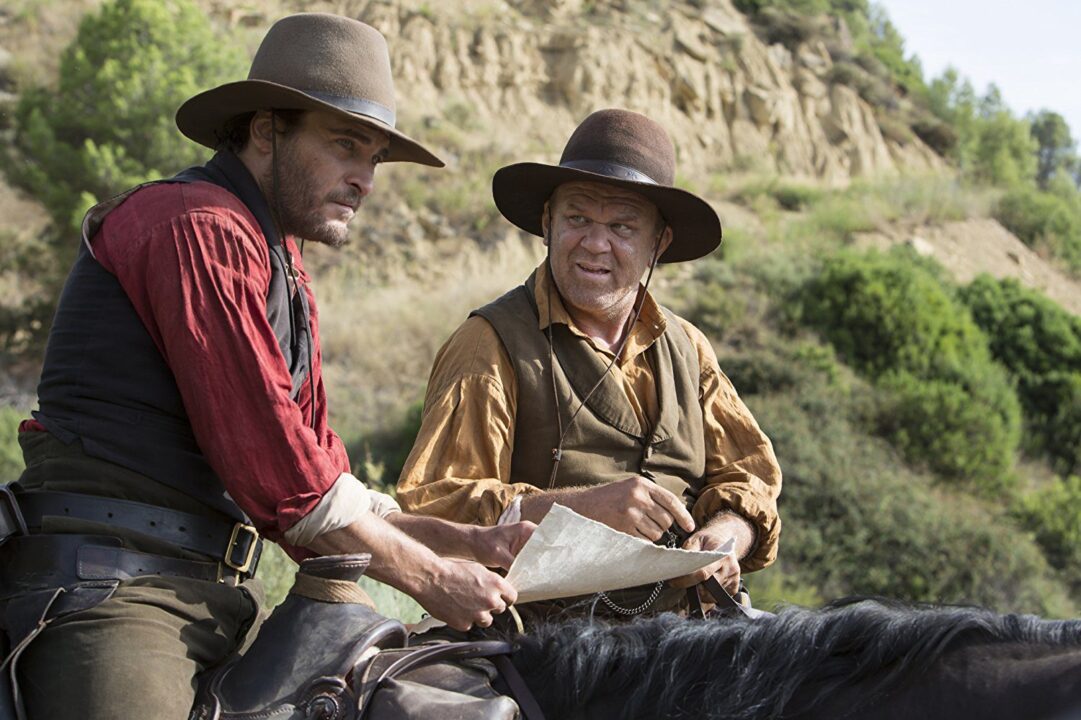
The first five minutes of The Sisters Brothers shows brains exploding out of the heads of men and horses on fire frantically running about.
There's no way around it, this film is intense. Set in the gold rush era of the 1850s, John C. Reilly and Joaquin Phoenix play contract killers on a mission in director Jacques Audiard's cross-genre dark comedy, The Sisters Brothers. This is one of those rare films that doesn’t fit into any specific box. It is a wonderfully wacky and weird exploration of manhood and how, when desperate times call for desperate measures, one will give an arm and a limb to get what they want.
Despite the sweet ring to their name, Charlie and Eli Sisters (Joaquin Phoenix and John C. Reilly) are more like angels of death to those they unfortunately encounter. For their latest mission, the brothers have been hired to find, capture, and kill the fugitive chemist Hermann Kermit Warm (Riz Ahmed) who is claimed to have invented a secret formula to easily discover gold at the bottom of rivers. Despite the ease of their previous murders, the task of finding Hermann becomes more complicated when John Morris (Jake Gyllenhaal), the brothers’ accomplice, proves to be more of an unforeseen hindrance than a help. This forces the brothers to realize that it's every man for himself in the wild, wild west.
Unlike the goofiness of another Western release this year, the Robert Pattinson-starring Damsel, The Sisters Brothers is much more stylish and grown up. Director Jacques Audiard explores different cinematic tones, never sustaining one for too long. Thankfully, this tonal mash-up doesn't distract from the more interesting components of the film- the complicated dynamic of the brothers' relationship with each other. They are brothers by blood but their personalities couldn't be more different and watching Phoenix and Reilly navigate through their emotional turmoil is darkly comedic.
For those expecting a straight-up comedy or Western, you should leave those expectations at the door.
The score is another element that adds to the overall mixed tone of the film. Without pulling from Western influences, Academy Award-winning composer Alexandre Desplat chooses to instead use piano melodies in minor notes to convey a feeling of uneasiness and occasional finger snapping to seemingly modernize the story's sound. We are in good hands with the French-born composer, whose previous credits include The King's Speech and Argo, among countless others. He takes us on a sonic journey that feels somewhat independent of the film, but complimentary nonetheless.
For as disturbing as the overall tone of the film is, it also has lighter tendencies, giving the audience a much-needed moment to shake off the grotesque images from prior scenes. While these moments are few and far between, the setup and delivery of the jokes aren't inherently "funny." In fact, there were times I wasn't sure if what I was laughing at was actually intended to be a joke. Watching ants crawl in and around vomit- not inherently funny, but in this context, maybe funny? Or just so uncomfortable that all I (and the rest of the screening room) could do was laugh.
For those expecting a straight-up comedy or Western, you should leave those expectations at the door. This portrait of life as familial assassins may not be the goldmine director Jacques Audiard was hoping for, but The Sisters Brothers' wholly original storyline and execution make for one entertaining film.
'The Sisters Brothers' is rated R for violence including disturbing images, language, and some sexual content. 121 minutes. Opening this Friday at The Landmark.
'Bel Canto' Review: All You Need is Love
Julianne Moore has played a scorned, stone cold intellectual in Maggie's Plan and a mother struggling with an early onset Alzheimer's diagnosis in Still Alice.
In both films, much like the rest in her extended repertoire, Moore is the centerpiece of an emotional catharsis and her performance shapes the films into memorable works. This may be why director Paul Weitz relied on such a tried and true movie star to bring both depth and drama to Bel Canto, a thrilling film adaptation, based on the award-winning novel by Ann Patchett, about an opera singer held hostage while performing abroad and the unexpected relationships she forms while being held prisoner.
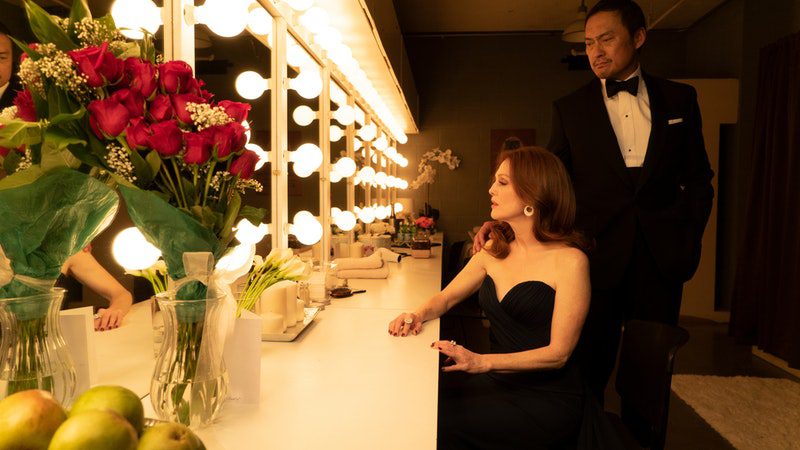
Wealthy Japanese businessman Katsumi Hosokawa (Ken Watanabe) arrives in South America to attend a party celebrating the upcoming factory his company plans to build in a nearby impoverished town. The lavish party, which takes place in a beautiful mansion, includes a full wait staff for the dignitaries flown in from all over the world. Katsumi doesn't get caught up in these high society details because he has his sights set on the guest of honor: the world-renowned opera singer Roxane Coss (Moore). However, his opportunity of a lifetime to hear Roxanne perform in such an intimate setting is cut short when anti-government terrorists storm the mansion and take everyone hostage, demanding to swap the innocent group in exchange for the country's President.
...The message is loud and clear: love is universal.
Being held as political prisoners is a terrifying reality for all involved, but Katsumi does everything he can to make Roxane feel safe. Despite the fact that this group of captives speaks different languages and comes from a variety of cultural backgrounds, the hostages do their best to connect with each other. Katsumi's bond with Roxane grows stronger by the day as she begins to let her guard down and allow her vulnerabilities to penetrate through her usually poised exterior. Days pass by while negotiations between the police and the rebels stall, yet inside the mansion, humanity begins to break down barriers with rebels as they open up to and form friendships with the hostages, and vice versa.
Ken Watanabe, better known as Katsumoto in 2003's The Last Samurai, is a stoic presence on screen. His performance is restrained and strong, yet his timing as to when to show his vulnerable side is perfect. Julianne Moore shines as Roxane Coss with the only caveat being the scenes of her singing where Moore, who is such a well-known actress, plays an opera singer whose voice is dubbed over by international opera star, Renée Fleming. Fleming’s vocal talent is breathtakingly beautiful but knowing that her voice isn't coming out of Moore's mouth can feel strange at times. Ultimately, a suspension of disbelief is necessary here.
Bel Canto is a very tight-knit film, with the majority of the story takes place in or around the mansion. This gives the audience a sense of the confinement the hostages feel. At times, it can play a bit too overly dramatic, but the message is loud and clear: love is universal. Love and admiration for others can cross language barriers, cultural differences, and distance. Now isn't that a beautiful thing to be reminded of every now and then.
'Bel Canto' is not rated. 102 minutes. Opening this Friday at Laemmle Monica Film Center, On Demand and iTunes September 21st.

'Age of Summer' Review: Young Love's a Beach
Hermosa Beach, 1986.
Although it was two years before I was born, the nostalgia of coconut sunscreen and bright neon activewear is timeless for any South Bay native, myself included. Director Bill Kiely and writer Dave Harris bring this feeling of endless summer to the big screen this Friday in the coming of age comedy Age of Summer, which is both a story about teenage self-discovery and a love letter to the beautiful beaches of Southern California.
Doug Mills (Percy Hynes-White), who goes by the nickname Minnesota, is a teenage transplant from Chicago who finds himself in Hermosa Beach after his family was forced to relocate. His awkwardness isn't lost on his peers- his scrawny build and boyish features make him an easy target for more mature kids who steal his rare and expensive bicycle and flaunt relationships with girls in his face. However, things begin to look up for Minnesota when he makes the cut as a Junior Lifeguard, a coveted opportunity among the locals. In order to secure his position on the team, he must complete a week of boot camp put on by the intimidating Australian tough guy Tony (Diarmaid Murtagh). Here begins Minnesota's summer of learning as his perseverance is tested both psychically and mentally.
Those who are familiar with the South Bay communities and Hermosa Beach, in particular, may get even more from this hometown indie film than the average viewer.
The exercises are tough, but the bonds that Minnesota begins to build with the other kids in the group, including the scene-stealing Woods (Jake Ryan) and his love interest Brooke (Charlotte Sabina), slowly give him the confidence to live authentically. Of course, his journey of self-discovery isn't without hiccups. His friendship with Woods is tested when Minnesota starts hanging out with the "cool" kids, and his moral compass drifts when he steals a marijuana plant in exchange for information about his stolen bike. Every experience that Minnesota goes through leads up to one moment, meeting a man known by the locals as The Rock God (Peter Stormare). The spiritual character, dressed in hippie garb and sporting a beard, reveals that an opportunity for a "cosmic do-over" of his life is forthcoming, which is a welcomed premonition for Minnesota.
There are many things to enjoy about Age of Summer, but those who are familiar with the South Bay communities and Hermosa Beach, in particular, may get even more from this hometown indie film than the average viewer. There are a few Easter eggs that are sure to make any local smile, like a cameo of The Beach Reporter newspaper, and the missing boy "Davie Harris," whose name sounds awfully similar to the film's writer, Dave Harris. A sweet nod to childhood, Age of Summer is ultimately enjoyable and charming.
'Age of Summer' is not rated. 89 minutes. Opening this Friday on VOD and at the Laemmle Monica Film Center.

'Kusama: Infinity' Review: Psychosomatic Polka Dot Princess
If you visited The Broad in downtown L.A. anytime between now and 2015 or saw your Instagram flooded with pictures of mind-blowing selfies in its Infinity Mirror room exhibit, then you've been exposed to Japanese artist Yayoi Kusama's work.
Known for her simplistic, yet avant-garde polka dot patterns, sculptures, and mirror play, the enigma that is Yayoi Kusama is explored in the documentary Kusama: Infinity. This arthouse film, which premiered at the Sundance Film Festival this year, is a wealth of knowledge packaged into a swift 77 minutes and is guaranteed to satisfy fans while piquing the curiosity of those who may have been previously unfamiliar with her work.
The film covers Yayoi's turbulent upbringing in Matsumoto City, Japan during World War II. In addition to the country's political turmoil and conservative view of the arts, Yayoi struggled to find acceptance within her community, with no help from her nonsupportive parents. Knowing that she was destined for worldwide greatness, she moved to New York City and began showcasing her work in small galleries and exhibitions. Eventually, her work caught the attention of the art world (rivaling Andy Warhol's fame) and she quickly began to make a name for herself. Currently, at 89 years-old, Yayoi Kusama is the top-selling female artist in the world.
Currently, at 89 years-old, Yayoi Kusama is the top-selling female artist in the world.
Of course, her story isn't without emotional pitfalls and unlucky streaks. The film's director, Heather Lenz, is sensitive to Yayoi's struggles and mental health issues when revealing her low points, including a failed suicide attempt and the fact that she started traveling with a psychiatrist in order to prevent panic attacks. The interviews that Lenz conducts with Yayoi, as well as top-notch curators from the Guggenheim, Tate Modern, and other notable galleries, give the audience an intimate look at this female Japanese outsider in the Western art world, whose work was surrounded by scandal and notoriety.
Yayoi Kusama is still alive today, living in a mental institution in Japan and continues to work and create. She never married or had children, thus, her legacy remains with her work. This doesn't seem to bother her, though, as she exclaims in the last line of the film, "I want to live forever." There is no question that Yayoi will be remembered forever as far more than just an artist. She is a visionary, underdog, feminist, and international icon.
'Kusama: Infinity' is not rated. 77 minutes. Opening this Friday at the Nuart Theatre.

'Pick of the Litter' Review: Love at First Sight
“A dog is the only thing on earth that loves you more than he loves himself.”
That quote by author Josh Billings gets me every time because I know that unconditional love he is referring to. I feel it from my dog, Ernest, every morning when he wakes me up with kisses only a mother could love. Most pet owners have a special bond with their animal, but there is something unique about the relationship between man and dog (they don't call them man's best friend for nothing). This sentiment is the perfect preface to Pick of the Litter, a documentary about the selflessness of working dogs- specifically as guide dogs for the blind.
Directors Dana Nachman and Don Hardy follow five dogs, from newborn puppies to adults, as they go through the laborious 20-month process of training to become certified guide dogs. Throughout the film's swift 81-minute runtime, Pick of the Litter is as heartwarming as it is educational. Aside from the obvious aww-inducing moments that are to be expected from a film about puppies, Pick of the Litter is full of interesting facts that prove how coveted the role of "Service Dog" is. One mind-blowing statistic reveals that, for the 800 dogs that are born as potential guide dogs every year, only 300 of those dogs will make the final cut as official service dogs. It further explains how dogs who are cut from the program, due to various qualities that make them unfit for service, are politely considered "Career Changed."
"...it is evident that these dogs mean the world to their owners and, as Josh Billings would argue, vice versa."
The film leads with a heavy hand, the opening sequence is extremely emotional as interviews with the vision-impaired portray incidents of how their previous service dogs saved their lives. Whether it was preventing someone from walking into oncoming traffic or leading them down 78 flights of stairs in the Twin Towers on 9/11, it is evident that these dogs mean the world to their dependent owners and, as Josh Billings would argue, vice versa.
Pick of the Litter is sincere in its mission to show the challenges and ultimate gift that a service dog is- an ability and freedom for the blind to explore the world. Lives are transformed as recipients are given the ability to live more independently, and while the process is not without occasional heartache, its beauty far outweighs the fleeting times of sadness. Pick of the Litter is a quintessential feel-good movie that is perfect for children, optimists, and dog lovers everywhere.
'Pick of the Litter' is not rated. 81 minutes. Opening this Friday at Laemmle Royal Theatre in West L.A.

'Searching': Not Clickbait
Without a doubt, one of the most original films to hit the big screen this year is Searching.
Searching is a "screen movie," meaning that the entire format of the film takes place as if it were from the point of view of a screen- be it a laptop, computer monitor, iPhone, or webcam. Much like how The Blair Witch Project revolutionized the "found footage" genre, Searching has the capability to make the genre of "high tech" films a growing staple in the ever-evolving Hollywood medium. Not only is it an astounding feat to create a feature film in this format, but the story itself, of a father's desperation to find his missing daughter, also stands alone as a chilling and emotional rollercoaster that stays with you long after watching.
David Kim (John Cho) is just trying to put the pieces of life back together after the unexpected death of his wife and family matriarch, Pam (Sara Sohn). Adjusting to life as a single father to their sixteen-year-old daughter Margot (Michelle La), he struggles to connect with the quiet and reserved high school junior. Aside from their weekly TV nights watching The Voice, David assumes Margot is acclimating to this "new normal" on her own terms and at her own pace. That is, until Margot fails to return home from a study group one night, prompting David to do a deep dive through Margot's past and online history. This brings to light shocking information that causes David to believe that he never really knew his daughter at all.
Fresh off the heels of 'Crazy Rich Asians', 'Searching' has its own statistics that are quite impressive in this current big box office landscape- this is the first mainstream, contemporary thriller headlined by an Asian-American actor.
One woman attempting to help bring Margot home is Detective Rosemary Vick (Debra Messing). Her no-nonsense attitude clicks with David's unwavering determination, and together, they weed out potential suspects, assemble search parties, and develop a platonic connection that is based on them both being parents. David also leans on his brother Peter (Joseph Lee) during this difficult time, but as days pass without any information, David becomes suspicious that things are not what they seem.
The merging of technology and filmmaking by first time feature director Aneesh Chaganty is a pure adrenaline rush. One doesn't have to be a millennial or familiar with the latest social media apps or hardware to enjoy the thrills in Searching. In one way or another, we can all sympathize with a parent's worst nightmare of waking up to discover your child is missing, gone without a trace. The format in which Searching was shot only heightens the suspense and, surprisingly, is never a distraction to the story unfolding.
It is, perhaps, the perfect time for the release of a movie like Searching. Fresh off the heels of Crazy Rich Asians, Searching has its own statistics that are quite impressive in this current landscape of big box office projects. As the first mainstream, contemporary thriller headlined by an Asian-American actor, Cho balances humor, grief, and optimism in his layered performance as a father looking for answers (fulfilling the wishes of the people behind the social movement #StarringJohnCho). On a more somber note, a story of the disappearance of a young woman seemingly out of thin air may remind those of Mollie Tibbetts, the missing Iowa college student who was unfortunately discovered deceased on Tuesday.
Searching premiered at the 2018 Sundance Film Festival, and despite its small screen containment, it is best experienced in a theatre. Hopefully, the success that comes from this independent film won't leave audiences "searching" for Asian-American representation in mainstream movies any longer.
'Searching' is rated PG-13 for thematic content, some drug, and sexual references, and for language. 102 minutes. Opening this Friday at ArcLight Hollywood and Sherman Oaks, and AMC Century City.

'The Swan' Review: Trouble in Icelandic Paradise
If fairy tales were real, I imagine they would take place in the Icelandic countryside.
Breathtaking landscapes of luscious grassy hillsides and crystal-clear lakes have the power to romanticize any story, even if they don't end in "happily ever after." A Reykjavik native herself, 34-year-old Ása Helga Hjörleifsdóttir makes her feature-length directorial debut with The Swan (Svanurinn), a coming of age drama that lends a tender touch to a tale as old as time.
Equally matching the idyllic setting is The Swan's protagonist, a curious and emotionally intelligent nine-year-old girl named Sól (Gríma Valsdóttir). When we meet Sól, whose angelic demeanor steals every scene, she is getting ready to leave her parent's house near the coast to spend the summer with estranged relatives in the country. However, this isn't a vacation, or even a choice, for Sól, but rather a punishment for getting caught shoplifting. As a consequence, her parents decide that spending a summer working on her aunt and uncle's farm to learn discipline through hard work, is just what their young girl needs.
Sól is immediately put to work, undertaking age-appropriate chores, while slowly starting to converse and become infatuated with, a twenty-something farmhand, Jón (Thor Kristjansson). Jón is equally fascinated with Sól, whose emotional maturity connects with his poetic ways. Their special bond is disrupted when Sól's older cousin Ásta (Þuríður Blær Jóhannsdóttir) returns home from college and disrupts the tranquility of the family's daily routine. As she is quickly thrust into situations far beyond her understanding, Sól struggles to make sense of the drama unfolding within the family. To cope with her changing situation and the sudden confrontation with life and death, she escapes into her own fantasy world comprised of vivid imagery within nature.
Martin Neumeyer's eye for breathtaking imagery is on full display here, literally, every frame creates a magical quality that gives off a feeling of optimism and rebirth.
The character of Sól is a dynamic one, and Valsdóttir's performance is nothing short of astounding. Sól is both confident and timid, with creativity and empathy that far exceeds her age. Her transformation from when she arrived at the farm to the film's very last frame is an exciting journey to witness in the short 91-minute runtime. It's undeniable that a major part of what makes this so fascinating is the cinematography. Martin Neumeyer's eye for breathtaking imagery is on full display here, literally, every frame creates a magical quality that gives off a feeling of optimism and rebirth.
Unlike Under the Tree, another recent Icelandic drama that portrays a dispute in the suburbs gone terribly wrong, The Swan shows rural Iceland in its purest and most beautiful form. Audiences, much like the film's protagonist, will stare wide-eyed at the natural beauty on display, while also being reminded of the strength of love, the power of compassion, and the meaning of life.
'The Swan' is not rated. 91 minutes. Opening this Friday at the Laemmle Royal.

'Skate Kitchen': Lords of Dogtown for the New Generation
This year, the films at Sundance have shown several women in female-empowering roles: Chloë Grace Moretz educated herself in the Grand Jury Prize winner The Miseducation of Cameron Post, Mia Wasikowska was nobody's damsel in Damsel, and Carey Mulligan found new life in Wildlife. In director Crystal Moselle’s highly anticipated sophomore feature film The Wolfpack, she adds the fierce young females of Skate Kitchen to this list. Known in real life as "The Skate Kitchen," these newcomers to the big screen take commanding roles that champion not just women, but women skaters who can kick-flip boards as easily as they kick butt.
Growing up in the Jersey suburbs of Long Island with her single mother and no close friends, Camille (Rachelle Vinberg) is a lone wolf searching for a community of like-minded chicks to skate and hang with. When she stumbles upon an Instagram profile called “The Skate Kitchen” – an all-girl skater group with mad style – Camille is intrigued: all talented, tough, and only a short distance away. She leaves her hometown for the unknown skate parks of New York City's Lower East Side just as soon as her board's wheels touch the ground, and upon finding the girl gang, is brought in as one of their own. Each with their vibrant style, Camille feels right at home with her new chosen family and the girls proceed to run and skate around the city.
With her second feature film, Crystal Moselle proves that one of her biggest strengths as a director is her ability to blend into her surroundings and capture the essence of her real-life subjects, which she did in 2015's award-winning documentary The Wolfpack. And here, Skate Kitchen feels no different. While Moselle infuses a loose script into Skate Kitchen, the strength of this movie is the more observational and improvised moments which straddles the line between documentary and narrative. Impressively, where Wolfpack showed a group of young brothers claustrophobic in their apartment-confined existence, here Moselle is let loose in the city and flexes her artistry even further, displaying a visual style that captures the electricity and grittiness of the concrete jungle bustling with danger and possibilities. Seen from the point of view of these young women, there is a high energy and honesty that especially shines in the skate sequences and hangout sessions that evoke feelings of Kids and Lords of Dogtown for this generation.
Seen from the point of view of these young women, there is a high-energy and honesty that especially shines in the skate sequences and hangout sessions that evokes feelings of Kids and Lords of Dogtown for this generation.
However, for all of the aesthetic praise that Skate Kitchen is getting – which is entirely due – I feel like there are a few missed opportunities in not developing the story even further, which ends up largely getting by by cashing in on its currency of cool. I was hopeful that Skate Kitchen would set out to provide more insight and hardships into what being a female skater is like in the male-dominated sport of skateboarding. We do see moments like this, like when the Skate Kitchen's spots get overtaken by the boys at the skate park, but more personal moments of womanhood feel awkward and out of place (for example, a hangout that turns into the girls discussing their menstruation cycles feel weirdly slotted into the movie). I did appreciate a scene in which the girls of the Skate Kitchen rush over and attend to one of the girls after she twists her ankle following a trick down a flight of stairs, running counter to what would be the more likely scenario of male skaters leaving the injured to walk it off.
More pointedly, the story ends up falling victim to the exact opposite of what it sets out to do – empower young girls – when the entirety of the plot turns into the conflict and fallout within the group after the introduction of a boy. When Camille begins hanging around Devon (Jaden Smith), a skater from a neighboring clique, the crew's camaraderie is examined, forcing her to question the validity and depth of her friendship with the girls. For a film led by a strong director who champions feminism and girl power, I was ultimately disappointed by this predictable and overseen trope.
That said, it's undeniable that Moselle has a magic touch when it comes to finding the subjects for her films. Just as she struck cinematic gold when she discovered the Angulo brothers of The Wolfpack, Skate Kitchen sees Moselle bring a new set of fresh female talent to the screen.
This review originally ran on January 29, 2018, during the Sundance Film Festival

'A Prayer Before Dawn' Review: The Merciless Shall Inherit the Earth
Twenty-nine-year-old Joe Cole has been slowly and steadily making his mark on indie filmmaking for years, but after this stunning and unforgettable performance as a troubled, drug-addicted boxer, he has surpassed the threshold from supporting talent to a commanding presence.
A relatively quiet release from power player A24, compared to the recent buzz of Eighth Grade and Never Goin' Back, the grisly biopic A Prayer Before Dawn may be flying under the radar, but it is fierce nonetheless. Based on the horrifyingly true story of an English boxer who wound up in one of Thailand's most notorious prisons, A Prayer Before Dawn is a visceral punch in the gut powered by the innate talent of Joe Cole.
The film begins in a ritualistic way as Billy Moore (Cole) applies globs of vaseline to his face before jumping into the ring. He doesn't speak, only the chanting and shouting of Taiwanese spectators fill the open-air arena. Moore is a boxer, and while it is unclear how or why he is pursuing a career in Thailand, it's apparent that he makes his money selling drugs. A crack-addict himself, it's only a matter of time before Moore gets caught and about 10 minutes into the film that happens, and chaos ensues.
Billy arrives at the prison scared, confused, and alone. Unfamiliar with the language and the sudden culture shock, Billy realizes the only way to survive is to put on a tough front. However, faux confidence isn't enough to stop him from getting repeatedly assaulted and mentally tortured. He watches as other young men are raped by older inmates in the most degrading of ways. The men are animalistic, tattooed and sweaty, and uphold the stereotypical imagery of degenerate Thai prisons. Corruption runs amuck between prisoners and guards, and the tension builds minute by minute. Internalizing this anxiety while trying to keep a brave face pushes Billy to the brink of despair. After partaking in a boxing match with other inmates, Billy gets a stroke of luck. His talent gets the attention of the prison guards, who offer him the opportunity to join the prison's boxing team, which means moving cells and leaving the abuse behind. With just months to train and his freedom on the line, Billy makes history by becoming the first foreigner to join the Muay Thai team.
Watching [Joe Cole] onscreen, you'll feel like you've also just gone through an emotionally taxing and exhausting 9 rounds of fighting.
Joe Cole, who rose to fame on the television show Peaky Blinders, shows his versatility as not just an actor, but a leading man. A Prayer Before Dawn may not be his breakout film, due to the film's arguably one-note execution that lacks emotional depth, but his performance is nothing short gripping. Watching him onscreen, you'll feel like you've also just gone through an emotionally taxing and exhausting 9-rounds of fighting. Director Jean-Stéphane Sauvaire's choice to not use extensive subtitles puts the viewer in Billy's shoes as we struggle to make sense of what is unfolding in front of our eyes.
A Prayer Before Dawn is based on the non-fiction international best-seller written by Billy Moore (who makes a well-deserved cameo at the end of the film). That said, there is much to be desired in the film adaptation- most importantly, delving into Billy's backstory. We only get a glimpse of what this man suffered through but, I wonder, if we knew more about who Billy was prior to his arrest and imprisonment, would we feel even more sympathetic towards his situation? Perhaps. That said, the raw energy that A Prayer Before Dawn creates is an accomplishment on its own, and another win for A24.
'A Prayer Before Dawn' is rated R for strong violence including a brutal rape sequence, drug use, and language throughout, some sexual content and nudity. 116 minutes. Opening today at ArcLight Hollywood and available to rent on Amazon Prime.
https://www.youtube.com/watch?v=Mp88Nuci68c