

'After So Many Days' Review: Newlywed Musicians Risk It All
Chasing a dream is often unrealistic, especially in the arts, because there can be high risks with little to no reward. Enter Jim and Sam, a band who’ve been playing together the last 10 years with the goal of building a real following. Though they have recorded albums and had some success, they have never had the following they envisioned. Having married 6 months earlier, Jim Hanft and Samantha Yonack decide to take their future into their own hands. They have one goal: play a live show every night for a year. Through the insanity of canceled tours and being together 24/7, Jim and Sam keep their love of music–and each other–as their North Star. The laughter and genuine connection make After So Many Days a must-watch for all.
Jim and Sam’s path as musicians trying to grow a following is not a unique endeavor, but their fearlessness to film their journey, warts and all, shows a vulnerability that not many are willing to explore. The film does not have a script or a production crew, but the unpolished, earnest nature of the filming adds to the charm that is their music. After So Many Days captures what Jim and Sam love doing most: playing music for people.
The most meaningful performances are the ones in unusual locations: a laundromat, a bodega, a gondola lift, and a nail salon; and these are where Jim and Sam find their own version of success. After So Many Days does not end with the fanbase they wanted, per se, but with a greater appreciation and understanding of why they love music: the connection. Back home after their last performance, Jim wearily encapsulates the worth of their adventure: “Music uplifts, it feels, it connects us all.” Jim Hanft and Sam Yonack's ability to build connections with those who gave them a chance and let them perform was far more rewarding than the fan base they thought they needed.
After So Many Days shows us how the pursuit of an idealized dream can be surpassed by our love for one another. We all yearn to connect and be understood, and this film is another way to unite us all. I am proud to say I am now a lifelong fan of Jim and Sam, and can’t wait to feel their magic and connection whenever performances can resume!
Distributed by Gravitas Ventures, 'After So Many Days' is now available on iTunes and Amazon, and will screen at Nashville Film Festival.


Truth, Lies, and COVID-19: 'Totally Under Control' is An Exposé You Need To See
With the presidential election 3 weeks away, it is not surprising that directors Alex Gibney, Ophelia Harutyunyan, and Suzanne Hillinger made sure their doc Totally Under Control, a look at the current administration’s mishandling of the Coronavirus pandemic, was completed and released as soon as possible. In order to conduct their interviews, the filmmakers and their crew ensured social distancing and secure camera setups, going as far as making “COVID Cams,” which were built offsite and delivered to the interviewees. For most Americans, the onslaught of news coverage has kept us all abreast, but Gibney, Harutyunyan, and Hillinger further expose the failures of the current administration and confirm that they better start packing.
Every doctor, health expert, and government official interviewed agreed that a pandemic was an inevitable threat and reality for the US. Dr. Rick Bright, BARDA Director from 2016-2020, explains that in 2019 the federal government conducted an exercise simulating a pandemic that used a highly lethal influenza that started in Asia. Not only is this eerily similar to Coronavirus and should have guided those in power with their decision making, but the biggest offenses came from a complete disregard to this data and playbook. Dr. Bright went into a meeting with the Secretary of Health and Human Services, Alex Azar, and used the data from the exercise to answer questions about how much money would be needed. His answer of $10 billion came from the 2019 exercise data and, as Dr. Bright put it, “ruffled feathers” and “created a shitstorm” resulting in Azar not inviting him to meetings for a while as a form of punishment.
An unsurprising takeaway from the doc is the downplay and disregard towards the research, science, and data during the early months of the pandemic. Dr. Mike Bowen, Executive Vice President of Prestige Ameritech, voted for 45 in 2016 and contacted the administration about the need to open US manufacturing of N95 masks multiple times. Instead, the CDC changed the guidelines to not use masks and specifically not N95. Furthermore, the documentary gets its title from an actual quote from 45 when asked what he was doing about COVID-19. The lying is second nature. Footage from his rallies is a disgusting display of ego-stroking and manipulation while the country dove headfirst into a recession with more than 200,000 deaths from his apathy.
Filming completed on October 1st, and the next day 45 tested positive for COVID-19. The irony is not lost on any of us, but if anyone thinks this will lead to any meaningful action then they are just as disillusioned as he is. Totally Under Control speaks to the importance of voting, and why we need to ensure that it is taken seriously in this election. This administration cannot continue. Please, make sure you have a voting plan, do meaningful research, and then vote!
Distributed by NEON, Totally Under Control is available On-Demand Tuesday, October 13, 2020, and on Hulu October 20, 2020.

'Siempre, Luis' Invites You to Meet the Latinx Activist That Inspired "Hamilton"
Luis Miranda’s name may not be as well known as his son’s, multiple Tony award-winner Lin-Manuel Miranda, but by the end of Siempre, Luis it is his name that you will always remember. This is director John James’ first documentary and he does an extraordinary job of creating a compelling portrait of an unbreakable man who is passionate about his family, his work, and his home of Puerto Rico.
Luis was known by his siblings as “the brain” and his parents had high expectations. He reminisced about the pressure to perform well in school, saying that if he brought home a mark of 95, his mother’s first question was, “Did anyone get 100?” His gut told him that he was meant for more, outside of Puerto Rico. In 1970, he moved to New York to attend NYU and quickly became a leader and liaison for the Latinx community. Luis helped his community organize their needs and voice into active voting. He demonstrated to the candidates how vital Latinx voters are by creating strategic campaigning for Latinx communities that hadn’t been done before. He worked on the campaign for Mayor Ed Koch as the Director of Hispanic Affairs, as well as Hillary Clinton’s campaign for the Senate, both of which won. His work on these campaigns and countless others created the space for Latinx politics and culture to be heard, listened to, and represented.
With impactful and touching interviews from Miranda, his family, and those who worked with him, James creates the portrait of an unbreakable man whose family and country come first, always. Luis looks at every challenge head-on and is never scared by them–so it’s easy to see how the apple (Lin-Manuel) inherited these qualities from the tree. The source of Lin-Manuel’s inspiration for his character Alexander Hamilton in his revolutionary musical Hamilton is clear, Luis is non-stop. Even after his heart attack in 2016, Luis would help Lin-Manuel open Hamilton at the University of Puerto Rico as a way to help rebuild after Hurricane Maria hit in 2017. Protests from employees seeking tuition reform for their children threatened the opening, but Luis found a way. In the short 4 week run, they raised almost $15 million for the arts and made sure that local Puerto Ricans had a set price of $10 a ticket, while tourists paid full price.
Siempre, Luis tells the beautiful story of a unique, proud immigrant who found a way to live his American dream and keep Puerto Rico closest to his heart. Miranda is passion and devotion personified. Lin-Manuel lovingly says that his father, “...is a relentless motherfucker,” and in the living nightmare that is 2020, I think we could have our leaders aspire to model themselves after Luis Miranda.
Distributed by HBO, Siempre, Luis is now playing on HBO and HBO Max, and On-Demand October 7, 2020.

'All In: The Fight for Democracy' is Your Look at Voter Suppression and How To Stop It
Quick Take: While it may feel easier to tune-out the current political, environmental, and emotional chaos of 2020, I urge you to engage with this defiant and informative documentary masterpiece about voter suppression.
With the 2020 presidential election soon approaching, we are still living in a pandemic, our economy is deep in a recession, and political unrest has led to parties weaponizing human rights to gain favor and power. And while it may feel easier to tune-out or self-preserve, I urge you to engage with the defiant and informative masterpiece that is All In: The Fight for Democracy. Lisa Cortés and Liz Garbus’ documentary shows how voter suppression has been instrumental in keeping Black voices silenced not only in the past but today.
The documentary follows Stacey Abrams, a voting rights activist, lawyer, and author, as she fights for the governor seat in Georgia. After barely losing to former Secretary of State Brian Kemp, Abrams continues to use her platform to combat voter suppression by shining a light on it. We hear from a variety of voices like Andrew Young, Eric Foner, and Lauren Groh-Wargo, who each add their own experience and expertise. This brings out an awful truth: voter suppression is a constantly evolving monster. Even during the time of Coronavirus, we see how voter suppression has evolved in most states’ primary elections and the ongoing debate around mail-in ballots.
All In teaches a necessary civics lesson and focuses on the hypocrisy of “All men are created equal.” The racism that our country is founded on has been prevalent throughout every political decision and tactic. The current Black Lives Matter movement reaffirms this fact. Our reputation of “Home of the Free, Land of the Brave” may have you wonder why it is so difficult to vote today, and the simple answer is power. Abrams says it best, “When elected officials feel that they may not have the power anymore, they have two choices: They can either be more responsive to those they lead, or they can eliminate the people they have to answer to.” Our representatives continually stand on the necks of our Black citizens because the idea of losing their position is greater than the lives they were elected to serve.
All In: The Fight for Democracy shows us the harsh realities that many voters face, but it does give us hope. Hope that we can do our best by exercising our right to vote. Hope that we can change with this election. Hope that we will not regress. Hope that we can become the America we always said we were.
Distributed by Amazon Studios, All In: The Fight For Democracy will be available on Amazon and drive-in theatres on September 18, 2020.

'Lingua Franca' Holds a Mirror to Evaluate Our Role in Transphobia and Anti-Immigration Reform
Quick Take: One of the most important films of 2020, Lingua Franca is a subtle and sensual story giving its audience a mirror with which to evaluate their role in transphobia and anti-immigration reform.
2020 has been a year of firsts: a global pandemic, masks as a necessity, education and jobs moving online. But the monumental achievement is the landmark film, Lingua Franca, making history as the first film directed and starring an openly trans woman of color, the deft and brilliant Isabel Sandoval. Sandoval’s voice as the screenwriter, lead actor, editor, and co-producer is a gift. She shares her experience and struggles with the audience, not to mention, her character has depth and intimacy never before seen due to the lack of representation historically for transgender voices.
The film is set in our current political world with 45’s fear-mongering hostility against immigration and gender identity impending and looming. Olivia (Isabel Sandoval) is an undocumented transgender Filipina woman working as a caretaker to an elderly Russian-American, Olga (Lynn Cohen), in Brooklyn’s Brighton Beach. The only way she can rid the constant fear of ICE raids and anti-immigration news is marriage and leaving love out of the equation. The constant panic and fear tap into the migrant experience, trying to make a life in a country whose citizens are spoon-fed rhetoric that immigrants are the enemy. When Olga's grandson Alex (Eamon Farren) comes back home after his time in some form of rehabilitation, he lives with Olga and becomes fascinated with Olivia.
"Lingua Franca" means a language that is adopted as a common language between speakers whose native languages are different. Nothing could better describe the relationship between Olivia and Alex. In the beginning, their interactions are focused on Alex learning Olga’s routine and how to care for her, and grows into a genuine interest in Olivia and her culture. As they become more intimate, they find their language but the secrets between them only continue to grow. The long pauses and tension between Alex and Olivia communicate far more than words ever could. Sandoval is a genius in these moments as she uses subtlety and framing, rather than heavy-handed dialogue and forecasting, to show Olivia’s isolation and true desire for love and romance
Lingua Franca is a subtle and sensual story giving its audience a mirror with which to evaluate their role in transphobia and anti-immigration reform. Isabel Sandoval shows us the heartbreak and living terror immigrant trans women experience in America daily. She has made a film with cultural currency and a story that needs to be seen by all.
Distributed by ARRAY Releasing, Lingua Franca is available on Netflix this Friday, August 28, 2020.

'Chemical Hearts' Will Get You In Your Feelings
Quick Take: Lili Reinhart gives a phenomenal performance in this YA adaptation, which sentimentally captures the fiery nature of teenage feelings.
When we fall in love, our brains are flooded with dopamine and serotonin, also known as the “love drugs.” This chemical concoction makes that attraction addictive. For Henry Page (Austin Abrams) this reaction happens almost immediately when he and Grace Town (Lili Reinhart) are partnered as Editors in Chief for their school newspaper in Amazon Studios' new film Chemical Hearts. Like many teenage romance films, this story is based on the Young Adult novel Our Chemical Hearts by Krystal Sullivan and the title refers to the chemical reactions in the brain that result from love.
What sets this romantic drama apart from the rest is writer/director Richard Tanne’s use of adolescent struggle and pain. Through Henry and Grace, we see that you cannot force your love on a person if they aren't ready. Tanne uses the idea of brain chemistry and chemical connections to heighten Henry’s attraction and tireless desire to be with her. But for Grace, the attraction is a welcomed distraction from the everyday reminder that her great love is gone forever.
Abrams and Reinhart’s carefully crafted characters are the most addicting part of this film. Abrams uses small, perfectly timed gestures and pauses to show Henry’s indecisive nature and eagerness to be with Grace. Nothing was more relatable than watching Henry try to craft a perfect text to send, one that would get Grace to respond, only to quickly erase it and sigh an admittance that that tactic is the worst. It's realistic and relatable, not to mention cueing my own memories of doing the same. Reinhart gives Grace layers and depth that show the intricacies and nuances of grief, and how depression can be incapacitating. She has been open about her personal journey with depression making this performance not only grounded but phenomenal.
Although the stereotypical teenage clichés are sprinkled throughout, Chemical Hearts captures the fiery nature of teenage feelings. Though we want our love story to be perfect and simple, Tanne reminds us that we all have cracks, and the hard part isn’t finding love but accepting ourselves.
Distributed by Amazon Studios, Chemical Hearts is available to stream on Amazon Prime Video today.

Mental Illness, Jesus Proclamations Fuel 'Three Christs'
Based on the book “The Three Christs of Ypsilanti” by Dr. Milton Rokeach, an empathetic doctor finds three patients who all believe they are Christ and begins to explore their identities altogether, in one room, believing there is a better way to treat and help the mentally ill rather than abiding by the industry standard.
Three Christs begins with Dr. Alan Stone (Richard Gere) recording notes for a trial. Right away, we are alerted that something went wrong, he is accused of or a witness to something terrible, and the film will focus on the mishaps of this study.
In the summer of 1959, Dr. Stone decides to leave his job and begins work at Michigan’s Ypsilanti State Hospital to study paranoid schizophrenics. Rather than using the techniques of his colleagues (electroshock therapy, inducing comas, drugs, and lobotomies), he wants to use group conversations, compassion, and understanding as treatment. This is unheard of and leads to many subplots of deception and manipulation by hospital chief Dr. Orbus (Kevin Pollak) who is skeptical of Dr. Stone’s altruism.
The three patients (Peter Dinklage, Walton Goggins, Bradley Whitford) have different and distinct personalities which are the most enthralling and interesting parts of the storytelling. Joseph Cassel (Dinklage) comes from an abusive upbringing and uses escapism to handle and manage the trauma. He uses an English persona to create his Christ and longs to visit England to continue his mission and ministry. Though the script has moving dialogue, it is Dinklage’s subtlety and nuance that make Cassel vulnerable and someone to champion.
While the male characters seem to have a clear motivation, Dr. Stone’s wife, Ruth (Julianna Margulies), does not. She is a brilliant psychiatrist as well, but decided to be a chemistry teacher. It is disheartening that Margulies' character is so underdeveloped; she is used as a function for Dr. Stone and his brilliance without one of her own. At the beginning of the film, she is seen as a strong, intelligent woman who quotes Freud and has a strong sex drive. By the middle of the film, she is consumed by jealousy and driven to drink because her husband has a young, attractive research assistant (which is how she and Dr. Stone met). This arc does nothing to further the study, or pose a conflict to Gere’s character’s mission. One begins to wonder why she is included in the narrative at all if the story could be told without her.
Although grounded in a historical study that challenged the inhumane treatment of mental illness, Three Christs does not play as a genuine nor thought-provoking film. The rising action and climax are predictable and detract from what could have been a strong message about our human dignity and duty. I wanted the entire film to push my comfort zone, to make me question what archaic, outdated practices are still standard in the 21st century, and then to strive to make them better.
THREE CHRISTS (2020)
Starring Richard Gere, Peter Dinklage, Walton Goggins, Bradley Whitford
Directed by Jon Avnet
Written by Jon Avnet and Eric Nazarian
Distributed by IFC Films. 117 minutes.
Now playing at Laemmle’s Monica Film Center.

'Light From Light' Explores the Meaning and Mystery of Life
From the trailer alone, one would expect Light from Light to be a classic paranormal thriller with jumps and ghosts galore. Instead, writer-director Paul Harrill gives us a character-driven drama that explores our human desire to create a life with purpose, and along that journey, we create our own internal ghosts. With the help of Greta Zozula’s cinematic eye behind the lens and the soft sounds of Adam Granduciel and Jon Natchez’s score, we enter a world where Shelia and Richard are haunted by past pains and recent traumas, and their journey together will lead to enormous revelations.
Shelia (Marin Ireland) is a single mother who has “the gift” of prophetic dreaming. At the beginning of the film, we watch Shelia’s radio interview about her career in paranormal investigation and her recent departure from that field. Shelia shows evidence of a jaded and reluctant self-image through the story of her first dream at eight-years-old. That experience gave her the “gift,” however, as she grows and continues sharing her dreams, she is asked if she’s a believer. Shelia expertly avoids answering the question, not sure what she believes in.
Richard (Jim Gaffigan) is recently widowed. His wife died in a private plane crash and now believes that her spirit is trying to communicate to him. From his keys being moved to where she stood in their kitchen to their bedroom lights flickering, Richard is searching for answers and what his purpose is now. When Shelia agrees to investigate, she brings her son Owen (Josh Wiggins) and his study partner Lucy (Atheena Frizzell) to help. Lucy is sweet and open about her feelings towards Owen. Conversely, he is protective and curbs the potential romance. He admits that he could fall in love with her, but with differing plans after graduation, he bluntly states, “...why get together if we know it’s going to end?” Little do any of them know that this exploration into paranormal phenomena will give them little clarity into the afterlife, but shine a light on how to best live the life they have, now.
Ireland and Gaffigan give performances that are modest and delicate yet rich in sensitivity. Those familiar with Ireland’s depth onstage will continue to be in awe at her sincerity and realism. Her interactions with Gaffigan show the gentle touch of a woman who wants to comfort and help, yet doesn’t understand how to turn inward. Fans of Gaffigan will expect a performance with hilarity but be delighted at the earnestness he brings.
The most impressive aspect of Harrill's script is that we are not given any solid, concrete answers. Harrill lets the audience draw its own meaning from the ending. This shifts the focus from “Is Richard being haunted?” to a study of how humans create a life of meaning with incomplete knowledge. And if the title is any indicator, we can gain light from life’s mysteries if we allow ourselves. – Ashley DeFrancesco
LIGHT FROM LIGHT (2019)
Starring: Marin Ireland, Jim Gaffigan, Josh Wiggins, Atheena Frizzell, David Cale
Directed by: Paul Harrill
Written by: Paul Harrill
Distributor: Grasshopper Film
Running time: 82 minutes
Playing: Opens this Friday at Landmark’s Nuart Theatre
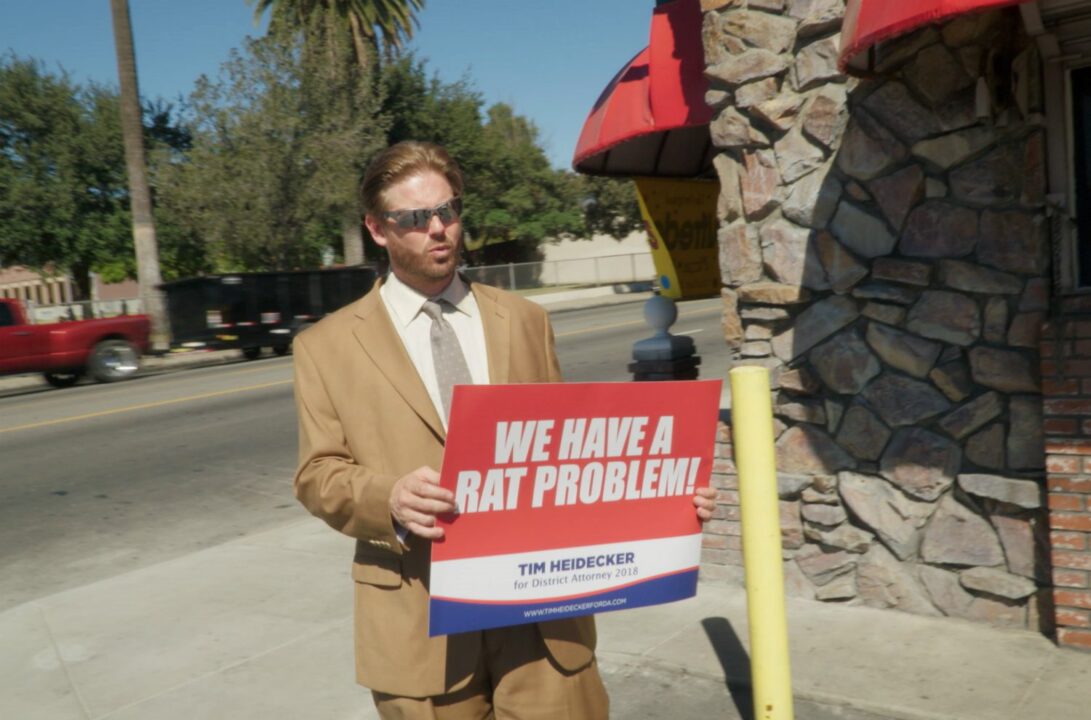
Comedian Tim Heidecker Runs For Office in Mockumentary 'Mister America'
MISTER AMERICA (2019)
Starring Tim Heidecker, Gregg Turkington, Terri Parks
Directed by Eric Notarnicola
Written by Tim Heidecker, Gregg Turkington, Eric Notarnicola
Distributed by Magnolia Pictures. 86 minutes. Opens in select theatres on Wednesday, October 9th at Alamo Drafthouse Downtown LA.
After the election of 2016, it’s impossible to imagine that another brash, egotistical TV personality could get elected to public office. Enter Tim Heidecker – yes, the actor and character have the same name – as he runs for District Attorney of San Bernardino, CA in the mock-documentary Mister America. It may seem that the purpose of this mockumentary is to answer the question, “Will this guy actually win?” but director Eric Notarnicola shows us how far actor, writer, and character Tim Heidecker will go to make himself, and politicians like his character, the punchline.
The character of "Tim Heidecker" comes from his podcast turned Adult Swim show On Cinema at the Cinema where Heidecker and Gregg Turkington co-host a local cable access movie review series. In the show, Heidecker is truly unaware of film and movies and gives meaningless critiques with the gusto and certainty of a Roger Ebert. This character is continued into Mister America as filmmaker Josh Lorton (Eric Notarnicola) follows Heidecker’s campaign to become District Attorney against the incumbent Vincent Rosetti (Don Pecchia). The motive for Heidecker’s sudden call to politics follows his trial where he was accused of killing 18 people during his Electric Sun Festival from malfunctioning vapes. As you may have guessed, Vincent Rosetti was the D.A. for the case. After Heidecker was found not guilty, he began his smear campaign against Rosetti calling him a “Rat” and threatening to run himself. Heidecker claims he is the best lawyer because he represented himself, got a mistrial, and took down the “Rat.” Even though this is a mockumentary, the name-calling and arrogance by those seeking political power feel all too familiar to our actual reality.
The parallels between Heidecker’s fictional character and real politicians are eerie, but a fascinating deep dive into how our political system works as a whole. Heidecker, Turkington, and Notarnicola do an expert job in picking apart what candidates must do during an election and expose the current themes of our elections since 2016. Most notable is Heidecker’s consist sound bite “Strong on crime, against corruption,” along with his promise to have a 100% reduction in crime. Not once does a potential voter, his campaign manager, nor filmmaker Josh Lorton ask him what his plan is, or how he’ll make this a reality. Rather, the brash and outlandish statement garners no critical thinking from any party. One of the more comical bits comes from the political signs that Heidecker takes to hang in restaurants with his slogan “We have a rat problem” in bold, large print. Only one place does not give him permission and it's hilarious to see how many others allow it, again, just blindly accepting because of his boisterous personality.
Mister America can be summed up best by Judge Edward Szymczyk’s (Curtis Webster) short and accurate description Tim Heidecker: “Style over substance.” We are left thinking how outrageous Heidecker is and called to reflect on current elections and the sideshows they have become.

'Memory: The Origins of Alien' Review: The Chestburster Scene and More
Alien captivated audiences by creating new nightmares beyond the typical jump cut and scare, forever changing the standards of the sci-fi genre. On the 40th anniversary of the film’s release, documentarian Alexandre O. Philippe takes this chance to dive deeply into the origins of Ridley Scott’s breakthrough sci-fi classic and the iconic “Chestburster” scene in Memory: The Origins of Alien. With the same attention to detail that Philippe used in 78/52 (dissecting the shower sequence in Alfred Hitchcock’s Psycho), lovers of Alien, sci-fi, and filmmaking get to explore the inspiration, genius, and creativity that made Alien a centerpiece of suspense and horror that, arguably, remains unsurpassed.
While Philippe shows how many minds and creatives came together to create the film, the one person without whom there would be no Alien was the late Dan O’Bannon. His lifelong fascination with comics, the sci-fi genre, and horror fiction inspired many of the beloved aspects and scenes. In one interview, it was shared that O’Bannon would joke that he didn’t steal from anyone, he stole from everyone. For example, the famous “Chestburster” scene has so many points of origin that it’s hard to truly trace the lineage, but it’s fun to see how every part helped to make the iconic scene. The 1951 DC comic Seeds of Jupiter was one part of O’Bannon’s inspiration, along with his obsession with H.P. Lovecraft’s Necronomicon, and even O’Bannon’s diagnosis of Crohn's disease which his widow said, “was devouring him from the inside.”
With the same attention to detail that Philippe used in 78/52 (dissecting the shower sequence in Alfred Hitchcock’s 'Psycho'), lovers of 'Alien,' sci-fi, and filmmaking get to explore the inspiration, genius, and creativity that made 'Alien' a centerpiece of suspense and horror that, arguably, remains unsurpassed.
The most impressive thing that Philippe does is acknowledge how Alien pushed boundaries in female equality, and how corporations missed this but audiences throughout the years haven’t. His first treatment, which was titled Star Beast before garnering the name we know today, had both interspecies rape and male pregnancy. And not one male producer even noticed. This begins to address the guilt patriarchal society felt in 1979 and are still uncomfortable talking about in 2019. Ripley is an amazingly captivating, fully realized, and dynamic role for a woman, which was originally written for a man. “It’s wonderful how the subconscious works,” an interviewee notes.
Alien has shaped how sci-fi and horror films can push and challenge its audience. One interviewee paraphrased how Lovecraft defined his style of horror fiction as ‘weird fiction’ saying that, “the essence of horror is the unknown. And what is most unknown, it is what is out there in the depths of space...” Memory: The Origins of Alien does just that: it gives us the essence of horror by breaking down how the unknown came together, and celebrating all sci-fi art that came before it. This is a delight for those who are avid Alien fans and lovers of sci-fi and should be embraced by those who want to continue to change the film industry, and our world, for the better no matter what the medium they use may be.

'Ladyworld' is a Thrilling Female-Adaptation of Lord of the Flies
LADYWORLD (2019)
Starring Ariela Barer, Annalise Basso, Ryan Simpkins, Odessa Adlon, Maya Hawke, and Tatsumi Romano
Directed by Amanda Kramer
Written by Amanda Kramer and Benjamin Shearn
Distributed by Cleopatra Entertainment. 93 minutes. Opens Friday, August 2nd at Arena Cinelounge Hollywood and VOD release Tuesday, August 27th.
We see nothing but black accompanied by the sounds of rumbling, shattering, and screaming: this is how we are introduced to the unsettling, unnerving state that is Ladyworld. What starts as a birthday party is quickly derailed as an earthquake hits and takes the majority of the house underground, trapping the eight girls inside with no idea of when, or if, they’ll be rescued. This all-female adaptation of Lord of the Flies, directed masterfully by Amanda Kramer, takes the novel’s powerful themes about the corruption of power and the human struggle between civilization and savagery and applies them to teenage girls giving a new perspective on the all-male novel.
The struggle for power between the girls is punctuated in-between moments of dread and unease. Each character is given many opportunities for reflection as they continue to fall into a paranoid state of mind and lose their false pretenses; growing into the beasts that lay dormant inside them. Like the “beast” in Lord of the Flies, the girls believe they are fearful of a strange man who is trapped in the house with them, but find it’s what they have developed into that they should fear.
Olivia (Ariela Barer) and Piper (Annalise Basso) show the polar oppositions during this event as the former struggles to maintain order and civility, while the latter quickly slips into savagery and uses a mob-mentality to garner followers. Both actors give strong performances and have the audience wondering how this group became friends.
Ladyworld uses the female perspective from its writers and director to capture feminine relationships and the intricacies within them. One of my favorite moments between Barer and Basso is when they are discussing why girls never really like one another. Piper has been told by her mother that it’s because girls are too competitive with one another and Olivia responds in disbelief saying, “Who? You and your mom?” Olivia then shares that her step-father told her it’s because girls just want a boy’s approval. I appreciate the way the writers highlight the many people in women’s lives who try to impress upon them what women need to value while continuing the negative rivalry between our gender and our own selves. The film does excellent work exploring how women react to morality and immorality through the harsh reality they live in, and how they struggle to remain friends.
There are many instances where Ladyworld expertly captures the tension of being trapped with no end in sight with the uncomfortable realness of female friendships being put to the test. Every actor gives a performance that plays with the dread of their situation and the rising tension as the factions grow and their true selves start to take over. It works because the viewer never feels safe. Ladyworld challenges its audience as it shows the true horror that can come when individuals want to feel in control, and when chaos is the only way to maintain that control.
https://www.youtube.com/watch?v=j5GEC67JHTk

Interest Turns Into Deadly Obsession in 'A Dark Place'
A DARK PLACE (2019)
Starring Andrew Scott, Denise Gough, Catherine Dyer
Directed by Simon Fellows
Distributed by Shout! Factory. 89 minutes. Not Rated.
Originally titled Steel Country when it made its way through the festival circuit, A Dark Place is the story of Donny (Andrew Scott), a sanitation worker, who becomes interested in the mysterious death of a young boy. After learning that police deemed his death an accidental drowning, Donny is determined to solve it. After a conversation with the boy’s mother where she makes a remark about how her son wouldn’t wander off alone, Donny is certain there was foul play involved.
Director Simon Fellows brings out the curiosity in each character and reminds us of what can happen to our mindset if we never explore the world around us. Cinematographer Marcel Zyskind does an expert job of bringing the small town in Ohio to life through his dark and atmospheric shots that show the deep and seedy underbelly of decay. He finds visually beautiful and striking imagery to establish the small, mid-American town we’re all familiar with. This collaboration makes the setting a living, breathing character throughout the film and one that adds dimension to the entire plot.
The film has moments where character-driven motivation is hard to find and leads to missed opportunities to educate its audience about prejudice when it comes to disability. Andrew Scott plays Donny as a man who is socially awkward, consistently missing social cues and jokes, which is never addressed nor discussed in the film. He may be someone that falls somewhere on the autism spectrum but seems to be high-functioning, because of the situations he is put into. From missing a joke and taking it at its literal meaning to becoming extremely fixated on solving the young boy’s murder, we see the same behaviors displayed throughout the media of humans with disabilities. These unanswered questions could lead to an audience questioning the characters mental health and detract from the actual storytelling. Due to his behavior not meeting society’s norms of how someone "should behave," Donny quickly becomes the main focus and suspect. This is a trope that many, many films have used and a fresher take would have been to cast an actor on the autism spectrum to give the viewer a true account and lens to see the character of Donny through. Scott is brilliant in his portrayal and keeps Donny grounded, real, and developed but with so many actors of varying backgrounds, identities, and life experience, I am left wondering how the story would have changed and grown with different casting.
The marriage between the unsettling tone of the movie and its small-town setting makes A Dark Place a masterpiece in how symbolism and subtly are a delicate art form. Simon Fellows and Marcel Zyskind do this well when showing how the town is rotting from the inside out. Flies continually buzz around Donny as he goes from house to house collecting trash. Not only is the garbage rotting but the small town itself is too as it turns a blind eye to find the killer. From the opening, it is quickly revealed that this film has something to say about the state of power in today’s America. Clean cut lawns with Trump/Pence signs along with closed down gas stations and warehouses that hang banners of the Presidential ticket as well let us know we are modern times. This is the America that felt underrepresented and ignored by the Obama administration. Where people lie and men abuse power to keep their power. Something that can be found not only in the fictitious town from the film but in many, many pockets of America today.
A Dark Place has so many points of view it wants to explore and messages it wants to deliver, but the lack of focus and clarity in the writing makes the film fall flat. While there are many great parts that can stand alone, the complete film isn’t truly a thriller. The resolution of the mystery and who killed the young boy is underwhelming and does not feel like the payoff the viewer deserves. Unfortunately, it reaches for tragic irony but doesn't quite make it due to inconsistencies and underdeveloped plot.
A Dark Place opens today at Arena Cinelounge Sunset and available on Amazon Prime Video.

'Unlovable' Review: Not Your Typical Manic Pixie Dream Girl
Unlovable is the type of independent comedy that executive producers Mark and Jay Duplass are best known for; quirky, relatable characters and a storyline with a heart of gold.
Director Suzi Yoonessi gives us much to admire in this film as she tackles difficult issues of addiction and recovery with playfulness, and co-writer/star Charlene deGuzman gives us a relatable protagonist who destroys the Manic Pixie Dream Girl that indie films consistently rely on.
The film begins with Joy (deGuzman) trying to kill herself by drinking a bottle of cough syrup from a DIY bedazzled glass, and we quickly recognize that she is deeply unhappy with her life yet unable to help herself as she has no knowledge of how to cultivate her own happiness. She is a love and sex addict who lashes out when she does not feel loved by her boyfriend, Ben (Paul James), by binge drinking and indulging in random hook-ups. After cheating on Ben, he dumps her and tells her to “get help.” Joy begins a 12-step program where she meets Maddie (Melissa Leo) and is in awe of her progress and journey. After getting denied to be Maddie's sponsee and getting ignored by Ben, her life quickly spirals towards rock bottom. She wakes up the next day to a harsh reality, finding that she was the main sexual attraction at a bachelor party (which she doesn’t remember), has lost her job on a children’s TV show after another missed called time, and is being kicked out of her apartment all within the same day.
The alluring charm of Unlovable is how it packages dark topics into a disarmingly light presentation. Written by Charlene deGuzman, Mark Duplass, and Sarah Adina Smith, the film is loosely based on deGuzman’s real-life experience in a 12-step program for sex and love addiction. The stakes of Joy’s troubles are plain to see and quite raw in deGuzman’s performance, which can be attributed to her closeness to the material. Rather than needing someone to fix her, which is a classic trope in romantic comedies, deGuzman lays bare her deeply troubled, desperately dependent soul as she struggles to take back her life. Even better is that deGuzman brilliantly pulls this off, yet remains amusing even when it’s obvious that she’s attempting to provoke members of her audience with the material.
Ultimately, Maddie recognizes Joy's pain and offers to be her sponsor. Maddie gives her temporary living arrangements in the guesthouse behind the home of her grandmother (Ellen Greer) as Joy tries to accomplish 30 days of sobriety. Maddie gives Joy two rules while living in the guesthouse: 1) She must go 30 days without alcohol or sexual activity, and 2) she can't interact with her brother Jim (John Hawkes), an emotionally aloof yet vulnerable musician who serves as their grandmother’s caregiver.
Rather than needing someone to fix her, which is a classic trope in romantic comedies, deGuzman lays bare her deeply troubled, desperately needy soul as she struggles to take back her life.
Throughout the film, Joy and Jim cultivate a healing friendship through their love for music. It would have been easy to let the film become one where they become lovers, or she becomes his muse, and by devoting herself to his needs he betters himself and she finds that being with him “cures” her. Thankfully, this movie is so much better than that, their relationship does not take the "only-a man-can-save-her route." Rather, Unlovable focuses on how Joy continuously tries to reinvent herself to varying levels of success and failure. Each blunder on her road to recovery is either hilarious or heartbreaking, but deGuzman’s performance illuminates how recovery is actually a combination of both.
The development of their friendship is the establishment of a mutual support system, something both of these broken souls desperately need. Hawkes, who wrote all of the film's original songs, delivers a masterful give-and-take with deGuzman as they build their friendship. Both push each other to become better and find that music is their common language and lifeline. In one instance, Joy is feeling hopeless and sadden by her struggle in recovery, and before they are going to perform a song Jim asks what's bothering her. Rather than answering, she strikes the drum set and captioning appears on the bottom of the screen. Jim replies by playing his guitar and his response then appears. They have their entire conversation in music, and then they begin to play their song. deGuzman and Hawkes expertly show us how friendship can save us during the darkest moments. Yoonessi’s direction is strong at this moment and gives us the gift of seeing how, even when we are in the deepest depths of our struggle, we can find someone who will listen, be there, and support us.
Unlovable is a fresh spin on the classic recovery narrative, and deGuzman’s voice adds honesty and sincerity that sets it far apart from others in the same vein. Joy’s choices are more often than not heartbreaking, but the film recognizes that easy fixes aren’t possible nor sustainable. I appreciate that Unlovable gives us a woman who is realistically flawed whom we root for in the midst of her self-destructive tendencies. You will enjoy the tender nature of Joy and Jim’s friendship and will cheer for both on their journey of self-discovery as they battle the demons they want to defeat once and for all.
80 minutes. ‘Unlovable’ is not yet rated. Opened Friday, November 2nd at Arena Cinelounge Sunset and available on Amazon Prime Video.

'306 Hollywood' Review: Love, Loss, and Grandma's Treasures
Elan and Jonathan Bogarin’s 306 Hollywood feels like a heartful trip down memory lane, and while that may not appeal to all movie-goers, it is one of the most relatable films you are likely to see all year.
It is a personal narrative that found many ways to express itself because the subject of the film, the Bogarin’s late grandmother, Annette Ontell, had numerous ways that she expressed herself! This story may seem small and have one ask themselves, “Why this story?”, but it will touch anyone who has ever lost a loved one, which makes it a universally appealing story, and quite large indeed.
After Annette Ontell’s death in 2011, Elan and Jonathan returned to the house where they spent many Sundays loving their grandma, 306 Hollywood Avenue in New Jersey. It looks like your average suburban house, painted white with a nice size front lawn and located in a quiet neighborhood. They viewed the house as her entire world since they only ever saw her there, and know that she was a former dress designer. As they begin to dive into the years worth of accumulated memories and mementos, our filmmakers realize that this house is a shrine, a monument, a ruin, and even a time machine to the woman that was their larger-than-life grandmother. They began to uncover the many layers about the woman they loved and are transported to how she lived before they were born.
After speaking with Sherry Anthony, a funeral director, our filmmakers learn that a soul will stay in the place that person loved most. They give themselves 11 months, the time a soul will stay put before moving into the next plain, to make their grandma tangible again in the house she, and they, loved. We are given many interviews with leading experts about their theories and ideas about what happens to someone we loved once they die, and how we, the living, are to process the death. I asked myself, “Don’t I try to find meaning when someone I love dies? Don’t I try to bring them back so the pain isn’t as strong?” This desire to reconnect with the part of us who died is something far more universal than most realize. Like our filmmakers, we search and scour for evidence that our loved one isn’t really, truly gone. Through every hand-made dress, homemade video, and molded tax book, we see our filmmakers experiencing grief as they try to find their grandmother in the house that they associate with her, and fail to bring her back. Which reminds us that we don’t really know what happens after death but we hope that our loved ones are someplace wonderful.
'306 Hollywood' does not have a star-studded cast, nor a plot that leaves audiences guessing at every turn, but it does something far more spectacular and meaningful. It reminds us that loss and grief are universal.
One of the most poignant interviews comes from the director of the Rockefeller Archive as he explains the importance of preserving records of the famous and powerful, but the equal importance of his own family's archive of treasures. This is something that runs throughout 306 Hollywood, the notation that value is weighted by those closest to the person, and that it can be found equally in things big and small. We see the Bogarins find value in big things, like the 10 years worth of interviews that they conducted with their grandma, and the small things, an extremely expired can of gefilte fish.
My favorite part of the time machine flashbacks were the interviews Elan conducted once a year from 2001-2011. These were like miniature studies in the nature of memory and revisionist history as we see how she edits the footage to showcase the woman she loves and memorialize the impact Annette had on Elan’s life. Over-the-top zooms and post-production music laid over seem to take away from the beauty of this found footage, except in one very raw and emotional moment. We witness Elan and her mother convince her grandma into wearing the dresses she made fifty years ago. She protests and laments about how she was ninety-five pounds, there is no way the dresses will fit on her, and that she’s wearing her sneakers while trying on these dresses. Elan’s mom finds her favorite dress that Annette made and wore, and is so happy when it does fit on Annette again. They are able to take a “still” of her in that dress from long ago, Annette makes one more comment about having to wear her sneakers while in the beautiful dress, and the moment comes to an end. This footage is emotionally charged and beautiful, as we see a genuine moment unedited. It’s straightforward and honest in how families interact with one another, and perfectly encapsulates the special bond, language, and love we share with our own families.
306 Hollywood does not have a star-studded cast, nor a plot that leaves audiences guessing at every turn, but it does something far more spectacular and meaningful. It reminds us that loss and grief are universal. That when in the midst of it, we search for that loved one wherever we can and are ravenous to know them better. Elan and Jonathan Bogarin have created a beautifully crafted love letter to the woman they considered their second mother. Their groundbreaking documentary turns the ritual of cleaning out their late grandmother’s house into a deep study of what happens to those who are left after a sudden loss. I think that one of the last lines in the documentary echoes the experience the audience goes through with the Bogarins, and even in their own dealings with a loss. “A house is a universe, an entire world. And it’s always amazed me when I go to the sites of houses I know, where the house has been removed. It’s always astonishing and appalling and outrageous that the footprint is so small. It’s like taking all of the stars in the galaxy and putting them in a thimble. To see all of that life put into a few hundred square feet on the ground.”
306 Hollywood is the cathartic movie we need when struggling through loss. Be prepared to fall in love and laugh with the extraordinary woman that was Annette Ontell, and weep as you reminisce about the extraordinary people who have come and gone in your own life.
94 minutes. ‘306 Hollywood’ is not yet rated. Opens Friday, October 12 at Laemmle’s Royal Theatre and Laemmle’s Town Center 5.

'After Everything' Review: The Pain of Accidental Significance
23-year-old Elliot (Jeremy Allen White) is the stereotypical millennial.
Holding a part-time job with no aspirations, he parties every night with his roommate and best friend Nico (DeRon Horton), using the power of allusion to help him get laid. Meanwhile, Mia (Maika Monroe) is a young professional in a job she hates, bored by the monotony of life. So begins directors Hannah Marks and Joey Power’s intelligent romance After Everything, which lets the audience live through Elliot and Mia's tender relationship while showing how disease intensifies love by introducing dependency and high-stake emotional investment in the beginning stages.
After a rather painful one-night stand, Elliot continues to experience a strange pain in his groin, which he assumes is an STD. His doctor finds a tumor on his pelvic bone, biopsies it, and diagnoses Elliot with a rare form of cancer called Ewing’s Sarcoma. Within the same week, he meets Mia while waiting for a subway train, recognizing her as a regular customer at his deli, and asks for her number without blinking. Soon, the two are diving head first into a passionate relationship due to the stakes of Elliot’s prognosis. His illness quickly becomes the glue binding their relationship together, as Mia becomes Elliot’s support system as he undergoes physically and emotionally debilitating chemotherapy treatments. She begins to find purpose, meaning, and a sense of fulfillment as she helps to care for Elliot, depending on him to fill the voids in her life. Elliot is just as guilty as he continues to act on his natural impulsive behavior by proposing to Mia in the park after he learns that the chemo is not working and he will have to undergo surgery, which has a 20% success rate. After the surgery is successful, the couple seems to be happy and enjoying their wedded bliss. Soon after the “honeymoon” stage of their relationship has ended, they realize that they don’t really know each other and what they believed to be deep, true love begins to fall apart.
Marks and Power do an excellent job at observing that in a crisis, people take on accidental significance. Any other time, it wouldn’t mean much if Elliot imagined the cute girl he just met in her underwear. But when this takes place in a sperm bank because the number of chemo rounds he must take may have the side effect of infertility, suddenly it seems as if she is "The One". This launches Elliot into a spiral that only Mia can help him through. They cross off items on his bucket list, which includes a hilarious scene with them taking ecstasy (but Mia makes sure to Google “What happens when you take MDMA and have cancer?”), and only continues to heighten their dependency on one another and perpetuate the misconception that they are destined to be together forever because they went through this together.
Jeremy Allen White and Maika Monroe have the kind of chemistry that filmmakers hope to achieve in romantic comedies, and will have audiences championing this star-crossed pairing.
Jeremy Allen White and Maika Monroe find the pathos and humor in every scene. White gives us a man who is detached due to fear of death rather than just being underdeveloped. White makes Elliot a believable 23-year-old- someone who often doesn’t know what he wants beyond a good time but he knows he’s found something special. Monroe’s Mia is lost and alone in a brand new city and grasps at any connection to make this place her home. She is loving and caring through her scenes with White which are conveyed through her choice of tone and dynamic. We see her strong and forceful, yet there is clear evidence of her motivation: unyielding love and loyalty to the man she loves. We experience her blind devotion to her boyfriend as she pours through endless articles to gain more knowledge, and doesn’t let doctors push her around just because she’s lacking the "Doctor" title. Monroe gives Mia the perfect arc to become the strong, independent woman by the end of the film. White and Monroe have the kind of chemistry that filmmakers hope to achieve in romantic comedies, and will have audiences championing this star-crossed pairing.
After Everything is extremely impressive from start to finish. It taps into universal themes of difficulties sustaining relationships at any age. We see how people can sabotage their future in an instant when the foundation isn’t given enough time to set. The cast gives remarkable performances that add dimension no matter the screen time. The writer/directors expertly craft a story that shows the reality of a fast-paced, high-intensity love and balance that with comedy that adds to the story, not detracts. If you are looking for a film that echoes today’s dating climate, pokes fun at the Millennial/Gen Z dating rituals, and leaves you feeling more whole and alive by the end credits, then you must go see After Everything.
95 minutes. ‘After Everything’ is not yet rated. Opens Friday, October 12th at Vintage Los Feliz Theatre